

Portable Potty Rules and Regulations (2026)
Portable Potty Rules and Regulations (2026)
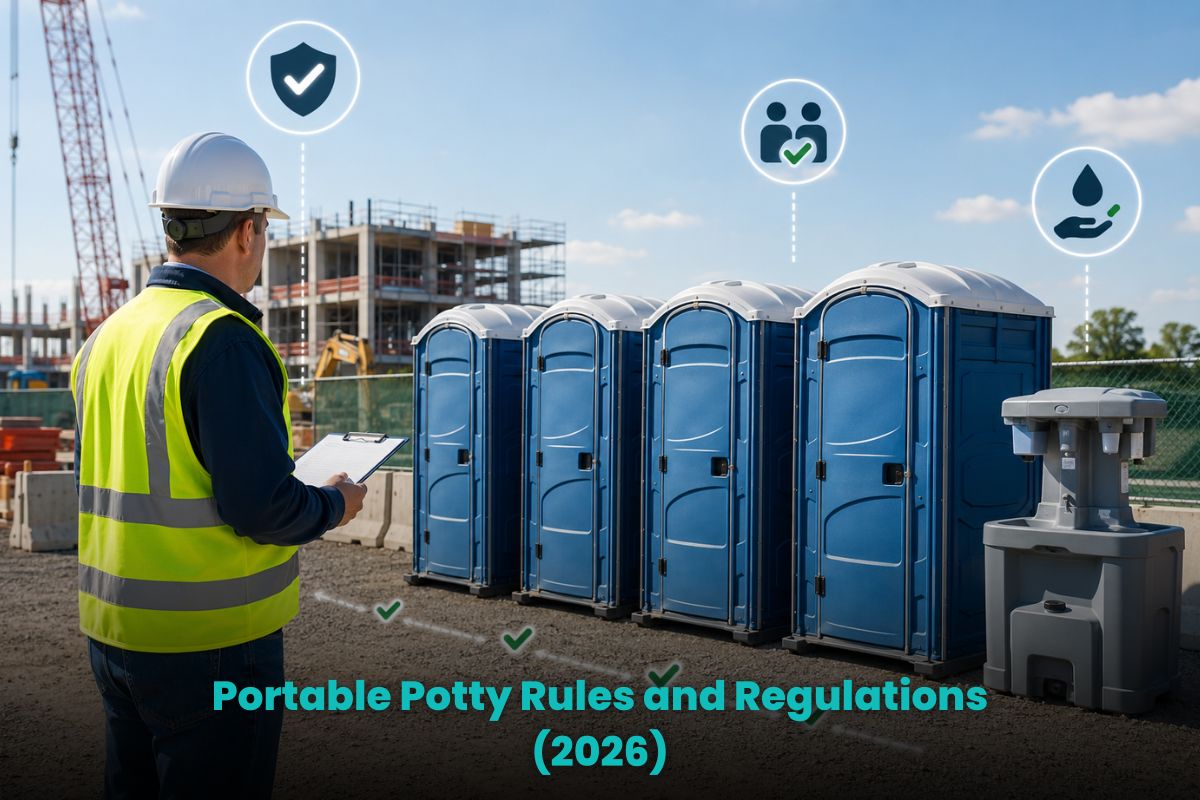
California's portable potty rules and regulations run three layers deep – federal OSHA, Cal/OSHA, and LA County Environmental Health – and knowing which ones apply to your project makes the whole compliance process straightforward.
The rules are specific, the ratios are calculable, and the permit requirements are clear once you know where to look.
We’ll cover everything: unit counts, placement, ADA requirements, handwashing, servicing standards, and LA-specific permit obligations.
Key Notes
- Cal/OSHA requires 1 toilet per 20 workers per sex – stricter than federal OSHA.
- At least 5% of all portable units on a site must be ADA-compliant.
- LA County events require 1 handwashing sink for every 4 public toilets.
- Serious OSHA sanitation violations can result in fines up to $16,550 per violation.
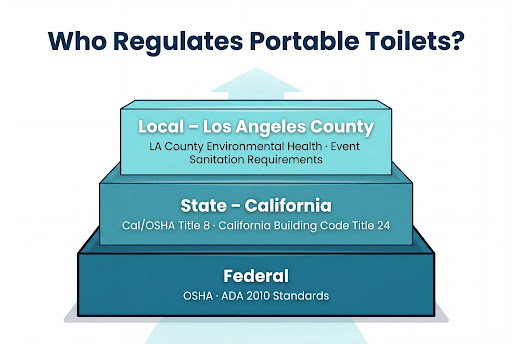
Who Regulates Portable Toilets? The 3 Layer Framework
Federal Level
OSHA sets the national baseline for workplace sanitation.
The key regulations are:
- 29 CFR 1926.51 (construction sites)
- 29 CFR 1910.141 (general industry)
- The ADA 2010 Standards for Accessible Design apply wherever toilets are provided, including temporary and portable facilities.
State Level
Cal/OSHA enforces California-specific rules under Title 8, including §1526 for construction jobsites. California frequently sets stricter requirements than federal OSHA, particularly around worker-to-toilet ratios.
The California Building Code (Title 24) adds technical detail on accessible unit specifications.
Local Level
In Los Angeles, the County Department of Environmental Health permits and inspects portable toilet rental agencies, pumper trucks, and sewage haulers.
For public events, LA County also publishes community event sanitation checklists with specific requirements for toilet counts, handwashing ratios, and placement.
The Critical Takeaway:
Compliance means meeting all three layers. Federal OSHA is the floor, not the ceiling.
OSHA Porta Potty Requirements for Construction Sites
OSHA requires that employers provide sanitary, immediately available toilet facilities at all workplaces, including outdoor and remote job sites. Where a sewer connection isn't feasible, portable units are explicitly permitted, provided they meet sanitation and access standards.
OSHA and Cal/OSHA Toilet-to-Worker Ratios
This is where federal and California rules diverge:
| Workers On Site | OSHA Minimum (Federal) | Cal/OSHA Minimum (California) |
| Up to 20 | 1 toilet | 1 toilet per sex |
| 21–200 | 1 seat + 1 urinal per 40 workers | 1 toilet per 20 employees per sex |
| 201+ | 1 seat + 1 urinal per 50 workers | 1 toilet per 20 employees per sex |
Cal/OSHA §1526 is the standard that governs LA jobsites, and it's meaningfully stricter:
- At a 60-person crew, federal OSHA requires roughly 2 units
- Cal/OSHA requires 3 per sex – potentially 6 units total.
A Few Additional Rules That Apply Regardless Of Crew Size:
- Separate facilities must be provided for each sex (unless units are single-occupancy with a functioning interior lock)
- Units must be "readily accessible" (within roughly 200–300 feet of active work zones, or no more than a 5–10 minute walk)
- All units must be maintained in a sanitary condition with toilet paper supplied at all times
Common OSHA Violations & What They Cost
The most frequent OSHA violations on construction sites are avoidable:
- too few units for the crew size
- units that haven't been serviced and are visibly unsanitary
- no handwashing facilities adjacent to toilets
- facilities placed so far from work areas that workers can't access them without unreasonable delay
The financial consequences are real:
Serious violations (inadequate units, unsanitary conditions, lack of access) can result in fines up to approximately $16,550 per violation under current OSHA penalty adjustments.
Willful or repeat violations can exceed $165,000 per violation. And failure-to-abate penalties accrue daily until the problem is corrected.
Portable Toilet Requirements for Events
Event porta potty regulations operate under a different framework entirely.
Rather than OSHA, public events in Los Angeles are governed by LA County Environmental Health, which sets sanitation requirements through the event permitting process.
Attendee-Based Ratios
The baseline planning figure used across California event guidance is 1 portable toilet per 50 attendees for events up to approximately 4 hours.
From there, the numbers adjust based on several factors:
| Factor | Adjustment |
| Event duration over 4 hours | +15–20% units, or schedule mid-event pump-out |
| Alcohol service | +15–25% additional units |
| Multi-day event | Scheduled servicing required to maintain compliance |
| Female-heavy crowd | Additional units recommended — lines will form faster |
To Put This Into Practice:
A 1,000-person, 8-hour event with alcohol service starts at 20 units (1 per 50), increases to 24 for duration, then to approximately 29–30 units accounting for alcohol.
That's the planning number before ADA units are factored in.
LA County Requires Event Organizers To Submit:
A written sanitation plan as part of the event permit application.
That plan needs to cover:
- unit counts
- ADA-compliant units
- handwashing ratios
- site placement diagram
- service schedule
Submitting without this information (or submitting figures that don't meet the health department's benchmarks) will delay your permit.
Porta Potty Placement Rules
Placement is one of the most overlooked parts of portable toilet compliance. The porta potty placement rules aren't just about convenience, but about safety, sanitation, and legal access.
The Core Placement Requirements
Units must be placed on firm, level ground where they won't sink, shift, or tip.
Service trucks need clear, close access. This is non-negotiable, and forgetting it causes real problems on the day of a pump-out.
Key Separation Distances To Build Into Your Site Plan:
- Food service areas: Keep units at least 50–100 feet from food preparation and serving areas to prevent odor and cross-contamination risk.
- Potable water sources: At least 50 feet from wells, streams, elevated water bodies, and storm drains.
- Active work zones (construction): No legally fixed distance, but industry standard is within ~200–300 feet. Units too far from workers create an access violation.
On Terrain:
Avoid soft ground, slopes, and areas where water collects.
Units on uneven ground create stability risks and often make ADA access impossible in practice, even if a compliant unit is present.
Public Right-Of-Way:
Most California cities restrict placing units on public sidewalks or streets without a specific permit. Some local ordinances also cap how long units can remain on residential streets, even tied to active construction permits.
The Most Common Placement Mistakes
These come up again and again (and they're all avoidable):
ADA Compliance for Portable Restrooms
ADA portable restroom requirements apply wherever toilets are provided – temporary and portable facilities are not exempt.
How Many ADA Units Are Required?
| Total Portable Toilets | Minimum ADA-Compliant Units |
| Fewer than 20 | At least 1 |
| 20–50 | At least 2 |
| 50+ | At least 5% of total, rounded up |
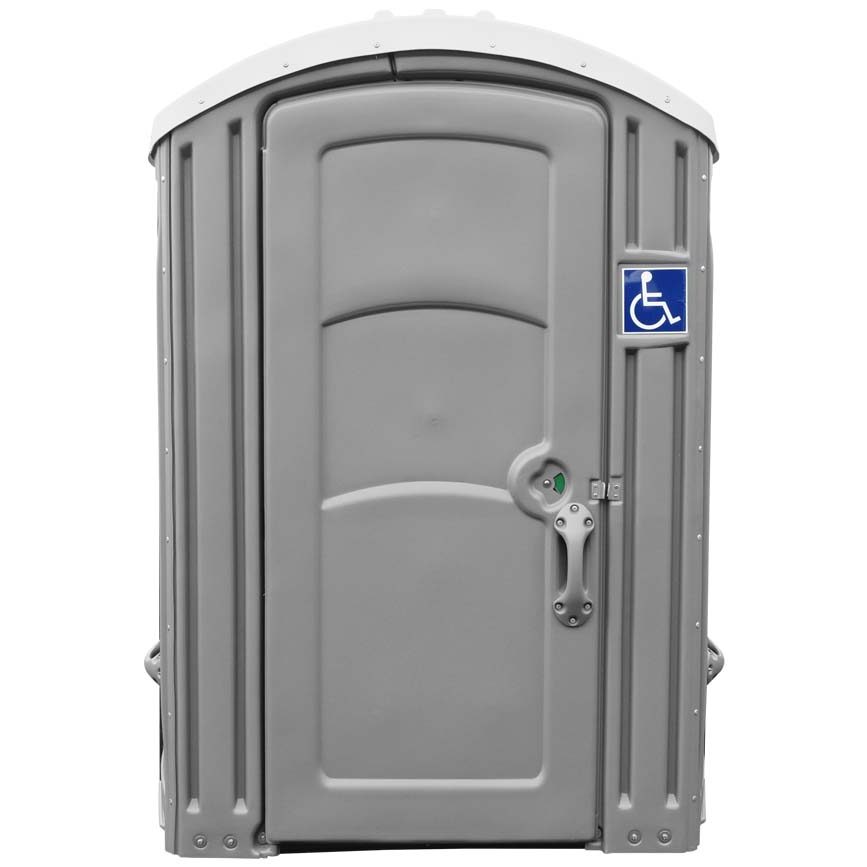
What Qualifies As An ADA-Compliant Portable Unit?
It's more than just a wider door.
A compliant unit needs:
- ground-level entry or a properly graded ramp
- clear interior turning radius for a wheelchair
- grab bars positioned to code
- appropriate signage
The accessible route leading to the unit must also be compliant – firm, stable, slip-resistant surface, no steps, maximum 1:12 slope.
Two Important Rules That Get Missed:
- Accessible units must be distributed across clusters, not grouped in one location.
- The accessible route must be kept clear – fencing, cables, and vehicles blocking the approach path to an ADA unit is itself a compliance failure.
Handwashing Station Requirements
Handwashing is a separate compliance requirement from toilet provision, and it catches a lot of people off guard.
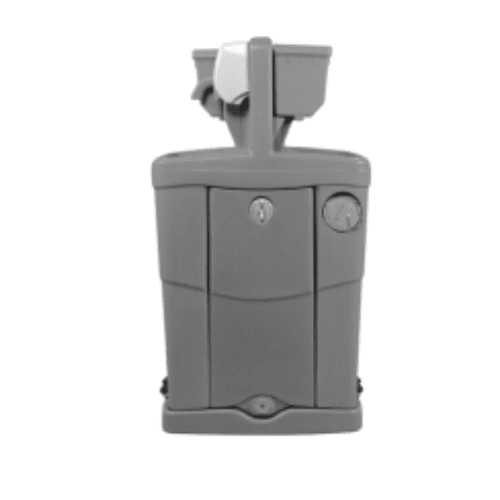
Hand sanitizer is not a substitute. OSHA's position is that soap-and-water handwashing facilities are required wherever employees may be exposed to contaminants or wherever toilets are provided at worksites.
Ratios By Use Type
Construction and general worksites:
- Approximately 1 handwashing station per 10–20 workers
- Stations should be within roughly 200 feet of toilet facilities
- Must supply potable water, soap, single-use towels, and a trash container
LA County public events:
- 1 handwashing sink for every 4 public toilets
- Dedicated separate sinks for food workers at each temporary food facility
- LA County requires warm water (~100°F), liquid soap, single-use towels, and a trash container at each station
Hand sanitizer can supplement handwashing, but doesn't replace it for compliance purposes. This applies to both OSHA-regulated worksites and LA County event requirements.
Sanitation, Servicing & Maintenance Standards
Portable toilet compliance is an ongoing obligation.
OSHA's standard is performance-based: units must be "maintained in a sanitary condition." There's no fixed cleaning interval in the regulation, but there are practical benchmarks that reflect what compliance requires.
| Usage Level | Recommended Service Frequency |
| 1 unit / up to 10 workers | At least weekly |
| 1 unit / 20 workers | Twice per week |
| High-traffic construction | 2–3 times per week |
| Large event or festival | Daily, or multiple times per day |
Responsibilities:
- Rental company handles pump-outs, cleaning, deodorizing, and restocking.
- Renter (contractor or event organizer) is responsible for ordering sufficient service visits, ensuring truck access, and reporting problems between scheduled services.
Documentation isn't legally mandated by OSHA, but service tags on each unit and digital route logs are standard practice (and they're your primary defense if a citation or complaint is filed).
Portable Potty Compliance Checklist
Use this as a pre-deployment audit regardless of project type:
Determine What Applies
- Identified scenario: construction, event, agricultural, or other
- Mapped regulatory layers: OSHA/ADA → Cal/OSHA → LA County / city permit requirements
Calculate Quantities
- Toilet count meets or exceeds applicable ratio (Cal/OSHA for worksites; LA County benchmarks for events)
- ADA units calculated at 5% of total, minimum 1–2, distributed across clusters
- Handwashing stations calculated and positioned correctly
Placement
- Units on firm, level ground with service truck access confirmed
- Separation distances from food, water sources, and work areas checked
- Accessible routes to ADA units verified – firm surface, no steps, correct slope, no obstructions
Servicing & Documentation
- Service schedule defined and written into vendor contract
- Vendor holds current LA County Public Health Permit
- Service logs or tags in place; disposal facility and hauler permits documented
Permits & Paperwork
- Sanitation plan included in LA County event permit application (if applicable)
- Site permits reflect compliant toilet counts (if applicable)
- Contracts clearly assign responsibility for counts, ADA units, servicing, and waste handling
Ready To Get Your Site Setup Right?
We'll assess your needs and recommend the right solution.
Frequently Asked Questions
How much does it cost to rent a porta potty in California?
Porta potty rental costs in California typically range from $100–$175 per unit per month for standard units, with deluxe and ADA-compliant units running higher. Pricing varies based on rental duration, service frequency, quantity, and site location.
How often does a porta potty need to be pumped out?
A portable toilet serving up to 10 workers needs pumping at least once a week – more frequently as usage increases. High-traffic construction sites and events often require service 2–3 times per week to stay sanitary and OSHA-compliant.
Can you put a porta potty on the street in California?
Placing a portable toilet on a public street or sidewalk in California generally requires a permit from the local city or county. Without one, units must be positioned on private property or within the project boundaries covered by an active construction or event permit.
Conclusion
Three regulatory layers, specific unit ratios, ADA distribution rules, placement distances, servicing schedules, and LA County permit obligations – portable potty rules and regulations in California cover a lot of ground.
The detail matters because each layer adds requirements that the one below it doesn't cover, and the gaps between federal minimums and California's enforcement standards are where most compliance problems originate.
Get the unit count right for your crew or crowd size, factor in ADA units across every cluster, pair your toilets with compliant handwashing stations, and work with a vendor who's properly permitted in LA County. That's the framework.
We’ve managed portable sanitation across Los Angeles for over 30 years – if you're figuring out what your project or event needs, get a free quote and we'll spec it out for you.