


Food Truck Power Requirements (& Power Options)
Food Truck Power Requirements (& Power Options)
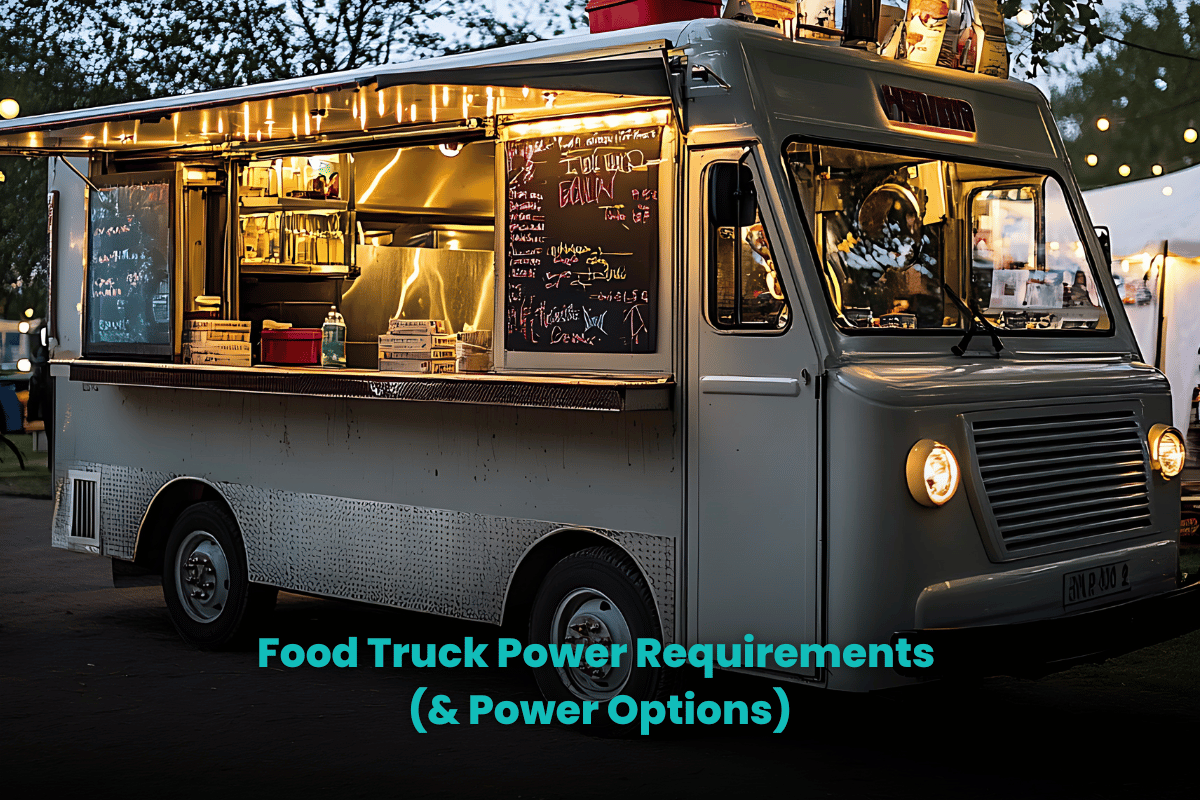
It’s amazing how fast a line of hungry customers can vanish when your power cuts out mid-order. One minute, the fryer’s sizzling and the espresso machine’s humming – the next, everything’s dark and silent.
Power might not be the flashiest part of running a food truck, but it’s what keeps the lights on, the fans spinning, and the food hot.
Here’s a look at food truck power requirements, from watts and amps to the best power options for every setup.
Key Notes
- Calculate load: list appliances, find wattage, add 20-30% safety margin.
- Coffee trucks need 3,000-5,000W; gourmet setups exceed 10,000W peak load.
- Temporary poles: $500-1,500 install, $100-300 monthly; cleanest mobile option.
- Stagger startups to prevent surges; prioritize refrigeration and ventilation first.
How Much Power Does a Food Truck Need?
Most food trucks run comfortably between 5,000 and 10,000 watts (roughly 50 to 100 amps, depending on voltage and equipment).
Smaller trucks – like coffee or smoothie setups – can get by with around 3,000 to 5,000 watts. Larger gourmet or BBQ rigs that run ovens, fryers, and multiple refrigerators can push past 10,000 watts during peak hours.
In practice, most food trucks are designed around a 50-amp electrical service – enough to power cooking, refrigeration, lighting, HVAC, and POS systems with some margin. For high-demand setups, that can scale to 80 or even 100 amps.
In practice, most food trucks are designed around a 50-amp electrical service – enough to power cooking, refrigeration, lighting, HVAC, and POS systems with some margin. For high-demand setups, that can scale to 80 or even 100 amps.
Understanding Power Basics
Let’s keep it simple:
- Watts (W) measure total power. Think of it as how much work your system is doing.
- Amps (A) measure current flow – how much electricity is being drawn.
- Volts (V) are the pressure that pushes that electricity.
They all connect through one basic formula: Watts = Volts x Amps.
Most food trucks in the US use 120V and 240V circuits. Lighter appliances like fridges, lights, and coffee machines run on 120V. Heavy hitters like ovens, fryers, and air conditioning need 240V.
Understanding these basics makes it easier to calculate what you actually need – and avoid tripping breakers when business is booming.
How to Calculate Your Power Load (Step-by-Step)
If you want reliable power, start with an accurate load plan. Here’s the process:
Step 1: List every appliance. Include refrigerators, fryers, ovens, coffee machines, blenders, lights, and ventilation.
Step 2: Find their electrical ratings. Check each appliance label or manual for voltage (V) and current (A).
Step 3: Calculate watts per item. Multiply volts by amps. For example, a 120V refrigerator drawing 10A = 1,200W.
Step 4: Add up the total. Sum all your wattage numbers to find your total running load.
Step 5: Add a safety margin. Add 20-30% for startup surges and future equipment. If your total is 6,000W, plan for around 7,800W.
Step 6: Match your power source. Your total wattage determines the generator or power pole capacity you’ll need.
This simple math keeps your system efficient, safe, and expandable.
Typical Power Loads by Food Truck Type
Power needs depend heavily on what you serve:
- Coffee & Beverage Trucks: 3,000–5,000W. Espresso machines, grinders, blenders, and small fridges dominate the load.
- Ice Cream Trucks: 2,000–4,000W. Heavy-duty freezers and soft-serve compressors are the main draw.
- Fast Food / Fry Trucks: 5,000–7,000W. Expect fryers, griddles, and ventilation hoods to eat up watts fast.
- Smoothie / Vegan Trucks: 3,000–5,000W. Lower cooking demand, but multiple refrigeration units.
- Gourmet / BBQ / Pizza Trucks: 7,000–10,000+W. Ovens, smokers, and multiple hot lines push these rigs to their limits.
If you’re running multiple high-power appliances at once, 50 amps won’t cut it. Always plan for your busiest moment, not your quietest.
Inside the Electrical Setup
A standard food truck usually includes:
- One 120V 15- or 20-amp circuit for small devices.
- One 240V 30- or 50-amp circuit for heavy cooking appliances.
Some larger trucks even add an additional 240V 50-amp circuit for HVAC or dual ovens.
Each appliance should be on its own dedicated circuit to prevent overloads. Use GFCI outlets for wet zones (like near sinks) and ensure proper grounding.
Typical inlet connectors include NEMA TT-30, L14-30, or L14-50 plugs – standard shore power connectors also used in RVs.
Food Truck Power Options
Generators (Gas, Diesel, Propane)
Pros:
- Independent and mobile power anywhere.
- Can handle large electrical loads.
- Widely available, easy to install.
Cons:
- Noisy and fuel-dependent.
- Require regular maintenance.
- Emissions can limit where you operate.
Most food trucks use 6,000 to 10,000-watt generators. Always pick inverter-style or quiet models when possible, especially for city permits.
Shore Power (Permanent Electrical Hookup)
Pros:
- Clean, silent, reliable grid power.
- Perfect for fixed locations, food truck parks, or private lots.
- No refueling or maintenance.
Cons:
- You’re tied to one spot.
- Installation costs can run $1,000–5,000.
Temporary Power Poles
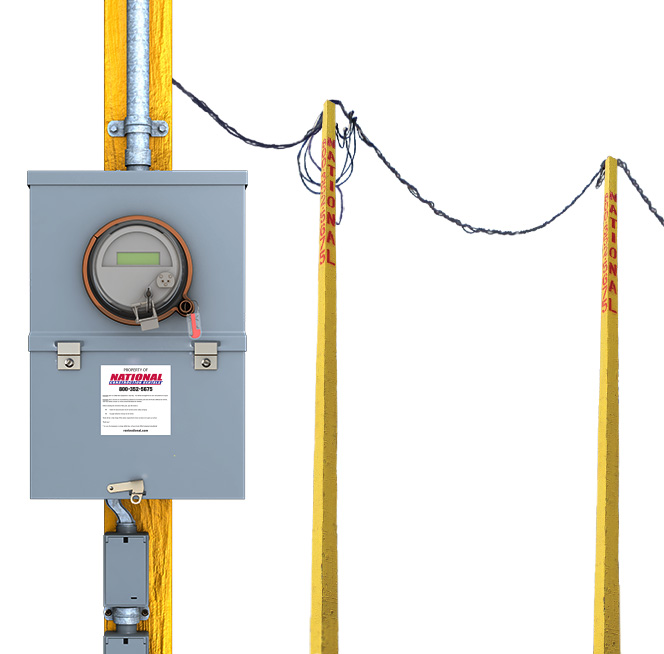
A temporary power pole connects your food truck directly to the utility grid – no noise, no fumes, and no refueling. It’s the perfect middle ground between a generator and a permanent hookup.
It’s best for festivals, markets, and event sites that have nearby grid access but no permanent power source.
Why It Works:
- Provides continuous, code-compliant 120/240V power.
- Professionally installed by licensed electricians.
- Flexible rental terms (often 8–12 weeks).
- Meets strict Los Angeles electrical and noise regulations.
Battery-Solar Hybrid Systems
Battery-solar systems like the EcoFlow DELTA Pro or modular Power Kits can deliver 3,600W continuous (up to 7,200W surge) with stackable batteries (2–15 kWh capacity) and solar inputs up to 4,800W.
Pros:
- Silent and emission-free.
- Recharge via solar or shore power.
- Lower long-term operating costs.
Cons:
- High upfront cost.
- Limited runtime under heavy cooking loads.
These systems work best for low-to-medium load trucks – think coffee, smoothie, or dessert trucks – or as a hybrid supplement to generators or poles.
Cost Comparison: Generators vs Shore Power vs Temporary Poles
Here’s what you can expect in Los Angeles:
- Generators: $500–$3,000 upfront. Add fuel, maintenance, and potential noise restrictions.
- Shore Power Installations: $1,000–5,000+ depending on site prep and distance to utility.
- Temporary Power Poles: $500–1,500 install; $100–300/month rental.
- Battery-Solar Systems: $2,000–20,000 depending on capacity.
For short-term setups (like festivals), temporary poles are usually the most cost-effective. For long-term fixed sites, shore power wins. Generators make sense for full mobility but come with higher ongoing costs.
Need Reliable Power For Your Food Truck Setup?
We’ll help you choose the right power pole for your load & location.
Reliability & Uptime: Keeping the Lights (And Fryers) On
Reliable power isn’t just about watts. It’s about smart management:
- Prioritize critical loads. Refrigeration, ventilation, and POS systems always get power first.
- Sequence startups. Don’t flip every appliance on at once; stagger them to avoid surges.
- Use monitoring tools. Voltage meters and load monitors help you spot problems early.
- Plan redundancy. Keep a backup generator or dual power input system ready for events.
Even a short power hiccup during lunch service can mean lost sales and spoiled ingredients. A solid electrical setup with headroom prevents that.
Safety & Code Compliance
Los Angeles food trucks follow National Electrical Code (NEC) standards, plus local fire and health regulations. Key rules include:
- GFCI outlets for all exterior or kitchen-area receptacles.
- Fire suppression systems and Class K extinguishers.
- Code-compliant shore power or temporary pole hookups (usually 50A or 100A, 120/240V).
- Proper grounding and bonding for all metal components.
- Regular inspection by the Los Angeles Department of Building and Safety.
Non-compliance can delay your permit or shut you down on the spot. Always work with a licensed electrician familiar with mobile food unit requirements.
Frequently Asked Questions
Can I run my food truck off a household outlet?
Not safely or efficiently. Standard home outlets (15–20 amps) can’t handle the 50–100 amp load of a food truck. You risk tripping breakers or damaging equipment. Always use a dedicated 240V circuit, generator, or temporary power pole.
How often should I service my food truck generator?
Most manufacturers recommend servicing every 100–200 hours of operation. That includes oil changes, air filter cleaning, and spark plug checks to keep the unit running smoothly and prevent breakdowns during service hours.
What size extension cord should I use for a 50A food truck?
Use heavy-duty cords rated for at least the same amperage and voltage as your service – usually 6-gauge for 50A at 240V. Anything smaller can overheat and cause dangerous voltage drops.
Can solar power alone run a full-size food truck?
Not yet, at least not reliably for high-load trucks. Solar-battery systems work great for coffee or smoothie setups but usually can’t sustain fryers, ovens, or air conditioning without a hybrid or generator assist.
Conclusion
Getting your food truck’s electrical setup right is the difference between steady service and a day full of outages and melted inventory.
Most trucks need 5,000 to 10,000 watts to keep everything running smoothly, but how you power that load depends on your setup.
Generators are great for mobility, shore power suits long-term sites, and temporary power poles strike the balance for events and semi-fixed operations – giving you clean, reliable energy straight from the grid without the noise or refueling hassle.
If you’re setting up your truck, get a free quote for a temporary power pole today. We’ll assess your location, power load, and schedule to get you connected quickly, safely, and fully up to code.